First, make sure the matrix is actually faulty
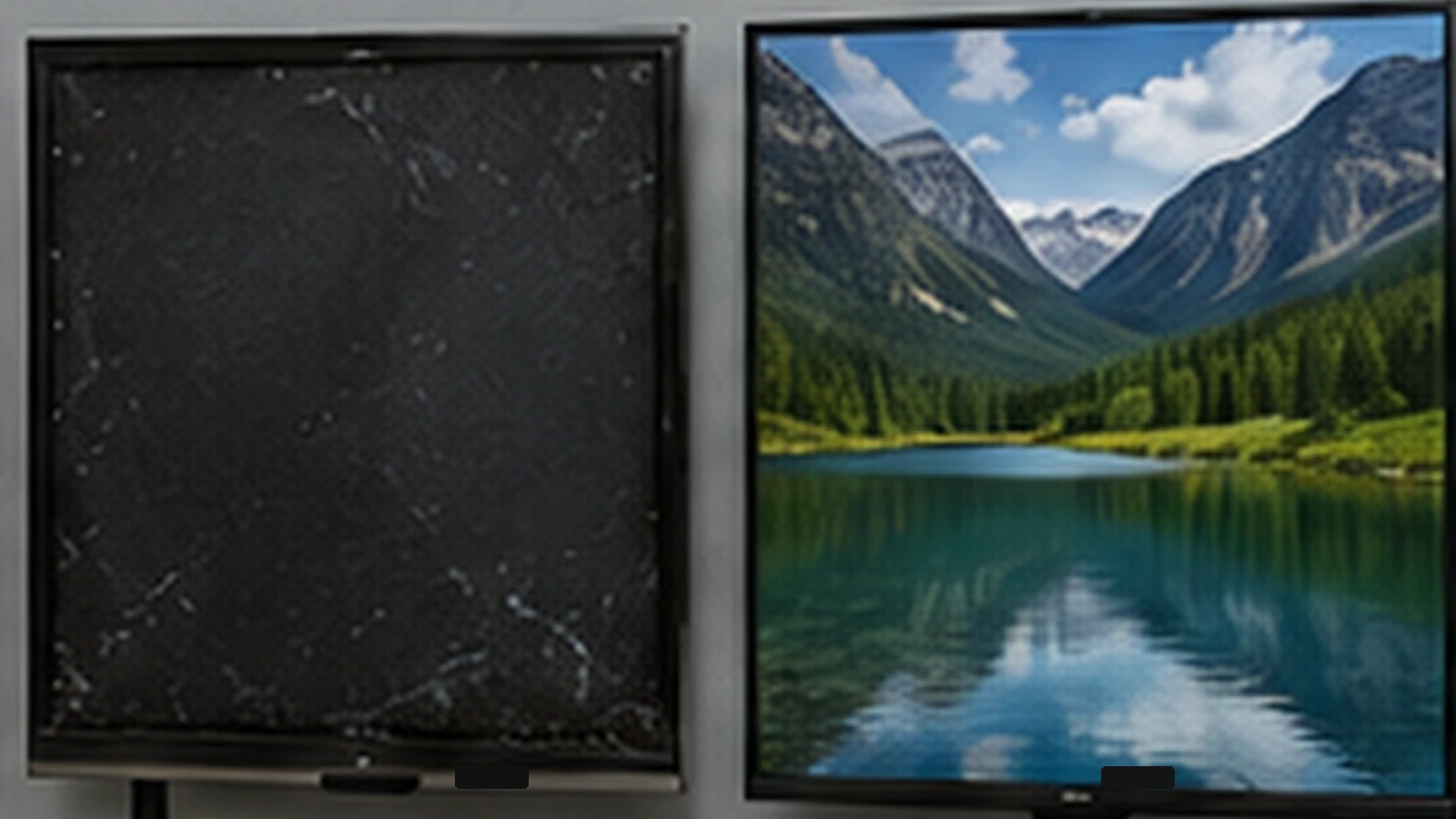
Cracks after impact, characteristic spreading of liquid crystals, or a physically broken panel are usually clearly visible. In such cases, the question is often not about diagnosing the cause, but about the cost and availability of replacement. It’s more complicated with electronic image defects. Stripes, half the screen, a white or gray screen, distortions, and an unstable picture can be related not only to the panel itself, but also to the T-CON, interface, cables, panel power, or the main board. Therefore, before buying an expensive panel, it’s useful to separate observation from diagnosis:
symptom → video path check → panel confirmation → locating the exact part → repair cost estimate.
Ordering a matrix based solely on a photo of stripes on the screen is risky.
What is commonly called the matrix
In everyday speech, the term “matrix” often refers to the entire display module of a TV. For an LCD TV, this is a thin and fragile panel that forms the image, with the backlight located behind it. In OLED panels, the light-generation principle is different, but the economic logic of replacing the display module remains similar: it is a large and expensive component whose compatibility must be confirmed. It is important not to confuse a failure of the panel itself with a backlight problem. If the image is being generated but cannot be seen due to lack of light, replacing the matrix is usually not the correct repair.
Why a single diagonal isn’t enough
Two TVs with the same diagonal can use completely different panels. For example, the same screen size does not guarantee a match:
- panel manufacturer;
- exact part number;
- type and layout of interfaces;
- electrical compatibility;
- mechanical mountings;
- module thickness and construction;
- backlight configuration;
- panel control parameters;
- TV hardware revision.
Therefore, a “55-inch matrix” is not a full part designation.
The TV model also doesn’t always give the complete answer.
The full TV model is an essential starting point, but sometimes it’s not enough on its own. Within a single commercial model, the manufacturer may use different revisions or panels depending on the batch, region, or production configuration. Reliable part identification is based on the actual markings of the installed panel and service documentation, if available. That’s why ordering an expensive display module before confirming its part number is not advisable.
What data to gather before searching for a panel
Before ordering, it’s useful to note down:
- 1. the exact TV model from the factory label;
- 2. the screen size;
- 3. the hardware revision, if listed;
- 4. the exact marking of the installed panel;
- 5. the nature of the damage or confirmed fault;
- 6. the condition of the casing, frame, and mounts;
- 7. the condition of the main board, PSU, and backlight, if it is a separate unit;
- 8. cost of the panel;
- 9. delivery cost and transport risk;
- 10. labor cost and the final repair cost.
The panel’s own marking can often only be seen after service access to the inside of the TV. That’s no reason to take apart a large matrix yourself: you can leave identification to a service center.
The main question is not the panel price, but the total repair cost
The part price is only one part of the calculation. The following may add to it:
- delivery of oversized and fragile cargo;
- packaging and insurance;
- disassembly and reassembly work;
- moving the frame, backlight, or other elements if the structure requires it;
- consumables;
- diagnostics of other components;
- the risk that a used panel has a hidden defect.
Therefore, the comparison should be not “a panel versus a new TV,” but the full repair cost versus the cost of a reasonable alternative.
When panel replacement makes sense
The panel is available at a reasonable price
If an exact compatible panel is found and the total repair cost is significantly lower than the cost of an equivalent replacement TV, the repair can be a rational choice. This is especially true when the panel is available locally or there is a suitable donor, and shipping costs are low.
The TV is a higher-end model
For a TV with quality electronics, good sound, a large screen, or an expensive platform, the cost of a working unit can be high enough to make panel replacement economically worthwhile. But the original price of the TV alone doesn’t settle the question. What matters is how much a comparable device costs today and what condition the unit being repaired is in.
The rest of the electronics are in working order
If the Main Board, PSU, backlight, and other key components have been checked and are in good condition, the chances of getting a fully functional TV after panel replacement are higher. However, if the TV also has power issues, an unstable Main Board, worn-out backlight, or signs of liquid damage, the overall budget and repair risk increase.
There’s a quality donor available
Sometimes an economically sensible option is a compatible panel from a donor TV with faulty electronics but an intact screen. In that case, you still need to check the exact compatibility and condition of the panel. “Same screen size” and a similar chassis are not sufficient criteria.
The device has additional value
Sometimes the decision is made not only based on market price: the TV may be built into the interior, have suitable dimensions, a rare set of connections, or be used in a system where replacing the model would create additional costs. This is a valid factor, but it should be considered separately from technical repairability.
When replacement is usually not cost-effective
A new panel costs almost as much as a comparable TV
If the total cost of the panel, delivery, and labor approaches the price of a working comparable TV, the economic sense of the repair diminishes. At the same time, a new or another working device may have an additional advantage in the form of a more recent platform and no accumulated wear on other components.
The panel is difficult to deliver safely.
Large LCD and OLED panels are very fragile. Even if the price of the part seems attractive, international or complex shipping can significantly increase the cost and risk. Transport damage can completely wipe out the economics of the repair.
Exact compatibility not confirmed
Buying a “similar” panel is a bad way to save money. If the interface, revision, or mechanics don’t match, the expensive part may turn out to be unusable.
The TV has other serious faults
If the Main Board, PSU, backlight, or chassis also need repair along with the matrix, the costs add up. In that case, the entire restoration project has to be considered, not just the screen replacement.
The panel is offered without the ability to test it
A used matrix may have backlight bleed, lines, dead pixels, pressure marks, degradation, or hidden driver defects. The less opportunity there is to test it before installation, the higher the risk of the deal.
How to assess the condition of the rest of the electronics
Before ordering an expensive panel, it is wise to conduct a full diagnosis of the TV.
Main Board
Check the stability of startup, operation of inputs, Smart TV, network functions, and the video path as much as possible with a damaged panel.
Power supply
Assess its operation under load and the absence of obvious instability. The presence of voltage without load does not by itself prove that the PSU is functional.
LCD TV backlight
If the assembly uses a separate LED backlight, its condition and age should be taken into account. Installing an expensive panel over a heavily worn backlight may lead to additional repairs shortly after restoration.
Housing and mechanics
After an impact, you need to check not only the glass. A deformed frame, mounts, or housing can make safe installation of a new panel more difficult.
New, refurbished, or used panel
In practice, the availability of a new original panel depends on the specific model. For some TVs, a donor unit becomes a more realistic source.
New panel
Advantage: predictable condition with a reliable supplier. Limitations: price, availability, and expensive shipping.
Donor panel
Can make the repair cost-effective, especially if the donor is available locally. It is necessary to check the image for lines, spots, damage, and compatibility.
“Refurbished matrix”
This term requires clarification. You need to understand what exactly was restored and by what method. For some panel defects, the durability of the repair may be uncertain. Do not take the word “refurbished” as a guarantee that the part is equivalent to a new one.
Why DIY replacement is especially risky
A large diagonal panel is a delicate structure, sensitive to bending, point pressure, and misalignment. Removing and installing it requires a flat work surface, the correct disassembly sequence, and usually a second person or specialized equipment. When replacing the LCD panel, it is also important not to damage the optical layers, flex cables, frame, and backlight. This is not the kind of repair where the risk is limited to the cost of a small board: one mistake can destroy the most expensive part.
Practical calculation before ordering
It’s useful to gather four numbers:
- 1. the cost of the exact panel;
- 2. delivery and related risks;
- 3. labor and additional parts;
- 4. the cost of a comparable working TV.
Then separately assess the condition of the remaining components and the likelihood of additional expenses. There is no universal percentage at which a repair automatically becomes worthwhile or not. For one owner, repairing a rare or expensive model makes sense; for another, replacing the TV is reasonable even when the price difference is much smaller.
Pre-decision checklist
Before paying for the panel, answer the following questions:
- Is the diagnosis of a faulty matrix confirmed?
- Is the exact TV model known?
- Has the marking of the installed panel been verified?
- Has the compatibility of the specific spare part been confirmed?
- Is the condition of the Main Board and PSU known?
- For LCD, has the backlight condition been assessed?
- Are the housing and frame free from deformation?
- Is delivery and the risk of damage taken into account?
- Is there a way to check a used panel?
- Is the full cost of repair calculated?
- Is there a current price for a comparable working TV?
- Is it clear what happens if the ordered panel turns out to be damaged or incompatible?
If several key questions remain unanswered, it’s too early to order the panel.
Conclusion
Replacing the panel makes sense not just because the TV is “expensive” or “still good,” but when several conditions are met at once: the panel defect is confirmed, an exactly compatible part is available, the rest of the electronics is in acceptable condition, and the total cost of restoration is justified compared to the alternative. The costliest mistakes happen before the repair even begins: ordering a panel by diagonal size alone, treating stripes as a final diagnosis, or overlooking shipping costs and additional faults. TV Repair specialists can perform diagnostics, determine the cause of the malfunction, and help evaluate the feasibility of repair before you order an expensive panel. Related pages: